How many, and how green? Dredging vessel orderbook appears to slow
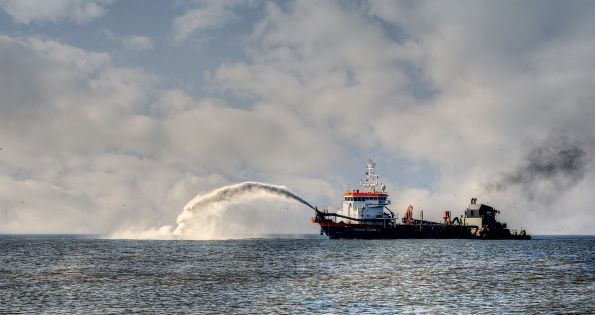
Dredger at sea. Credit Pixabay
The green transition and pressures to decarbonise; soaring shipping rates; changes in trading patterns; increased tonne-miles; decisions on when or if to scrap – all these are key drivers when it comes to newbuilding orders and deliveries. But across the global fleet, the nuances vary and priorities shift sector by sector.
Clearly, dredging operators are not subject to the same extreme swings as the container sector; nor do they have major retailers as customers exerting as much external force for greener logistics. So, what are the priorities and how is the orderbook right now?
According to S&P Global Market Intelligence, there are 25 dredging vessels on order globally, due to come online during the rest of this year, in 2025 and into 2026 – this figure refers only to vessels which are self-propelled and able to travel in international waters.
Of these, 11 are scheduled to launch in the final months of 2024 – two in September, two in October and then there will be a final surge of seven in December. Of these 11, four are cutter suction dredgers and seven are trailing suction hopper dredgers (TSHD). Speaking to Ceda Industry News (CIN), Ines Nastali, senior maritime data expert, S&P Global Market Intelligence, noted that TSHDs remain the most common type of dredger within the self-propelled category, adding: “Given its versatility, it’s no surprise to see this trend continued in order numbers.”
However, next year’s figures (2025) indicate a possible slowdown in orders, 12 vessels are due to be launched – six cutter suction dredgers, five TSHDs and one suction dredger. In 2026, at the time of writing, two TSHDs are scheduled for launch according to S&P.
To date, eight vessels have already been launched in 2024, six TSHDs and two water injection dredgers. In terms of capacity, the TSHDs already delivered and due for delivery in 2024 will add 100,000 cu m of hopper capacity into the market; the TSHDs scheduled for launch next year will add 47,000 cu m; and those scheduled for 2026 will add up to 33,000 cu m of hopper capacity.
Future fuel uncertainties
As shipowners in all sectors grapple with decisions around decarbonisation and which potential ‘future fuel’ to opt for, there is concern that many are holding back on ordering, waiting for others to take the lead. Bearing in mind that vessels ordered today are likely to be in operation way beyond the IMO 2050 deadline, and it’s easy to see why this matters.
Take a look, for example, at Jan De Nul fleet of THSDs – the stalwarts still in operation include the 11,750 cu m hopper capacity James Cook built in 1992, the 18,000 cu m Gerardus Mercator built in 1997, the 9,000 cu m Alexander von Humboldt built in 1998 and the 33,000 cu m Vasco da Gama built in 2000.
Nastali of S&P Global Market Intelligence, said that of the vessels already launched this year, all but one will run on distillate fuel. The only exception is the 1,500 cu m diesel-hydrogen-electric Hydromer, a 70-metre TSHD built for the Occitanie/Pyrénées-Méditerranée Region in France for the maintenance of harbours in the Gulf of Lion.
Actemium Marine was responsible for the overall electrical installation of the vessel, which included diesel-hydrogen-electric propulsion, energy conversion and management, ship controls and dredging system controls. Actemium also integrated a 200 kWe hydrogen fuel cell into a container, to power electrical components on board. “This innovative integration enables to save up to 20% of the vessel fuel oil consumption, underscoring Actemium’s commitment to decarbonising maritime solutions,” said Actemium.
Of the 11 vessels still to come in 2024, the story is the same – all will run on distillate fuel with one exception, CCCC Shanghai Dredging’s dual-fuel Xin Hai Xun TSHD, launched in January and due for delivery soon.
The Xin Hai Xun is described by the China Classification Society (CCS) as the first independently developed 10,000-ton large green energy TSHD; built for waterway dredging and filling projects in the Yangtze River estuary area and coastal ports in China, it will also serve as a multifunctional TSHD for coastal maintenance projects.
Built by Shanghai Zhenhua Heavy Industry Co., Ltd. (ZPMC), the 17,000 cu m hopper capacity vessel has obtained the CCS ‘Natural Gas Fuel, dredging within R2, AUT-0, OMBO, DP-1’ class notation and “will inject new momentum into the development of green and clean shipping in China”, said CCS.
“The design concept of Xin Hai Xun is closely related to the national strategic goal of ‘carbon peak and carbon neutrality’ and the current construction needs of green port waterways,” said CCS when the vessel embarked on successful trial sailing in July.
The ship has been designed to use LNG as its primary power source. If LNG filling conditions cannot be met, the vessel uses a backup diesel power system.
“Since 2017, there have always been one or two vessels being launched that are able to also run on LNG, likely in addition to distillate fuel,” says Ines Nastali. “The current fleet order reverses this trend with one LNG-dual fuel vessel on order.”
This small dip in dual-fuel vessels, could indicate a move away from LNG due to doubts over its green credentials or uncertainty over which alternative fuels to bank on in the coming decades. Some dredging companies, however, are making investments on dredgers that will be able to use future fuels. Arno Schikker, manager of corporate communications at Boskalis, told CIN, Boskalis currently has one large trailing suction hopper dredger under construction at Royal IHC “which is being prepared for the use of (green) methanol…and will be put into use mid-2026.”
Shipyard shortages
As shipowners in other sectors seek to place orders, another challenge is a shortage of slots in the shipyards, leading to long lead times and high ship prices. Some Chinese yards, previously mothballed, are being reopened to meet demand.
All the current suction dredgers on order – total installed power ranging from 2,000 to 4,000 kW, putting them in the small-to-mid-range categories, are being built in Bangladesh. Most of the rest of the dredgers on order are being built in China and the Netherlands, says S&P.
At this point in the year, of course there is time for further orders to be placed. However, after the surge of TSHDs coming online in December, there appears to be a slowdown in orders going into 2025.
Ines Nastali says: “Overall, the vessels scheduled for delivery range in sizes and in terms of who the owner is, so this seems to be in line with prior newbuilds entering into service. Looking at the five-year average, 17 dredgers with IMO numbers [i.e. self-propelled and able to travel in international waters] have entered into service every year between 2020 and 2024. This year, 19 vessels in total are scheduled to enter into service, slightly above the average. There is also the possibility of delays into 2025 for some of those scheduled for delivery in late 2024.”
Owners are uncertain which alternative fuel to opt for, given the market volatility and the fact that there are several options, including biofuel, wind power, ammonia, hydrogen, methanol, LNG, etc., she says. “The emission regulations amendments/evolution make it even more challenging for them to invest in a technology, which may not support long-term IMO initiatives – methane slip being one of them.”
There is no clear guideline on dredgers to comply with MARPOL Annex VI and many dredgers on order are below 400 GT, she points out. “They don’t trade like normal conventional tonnage calling country by country. Only those premium dredgers, which intend to operate in developed countries, due to local limitations on emissions in protected areas, will equip the ship with energy-saving devices such as the current preferred option of battery-assist or alternative fuel such as LNG or biofuel, which is preferred due to supply availability in operating regions.”
DEME has taken a dual-fuel approach with the Yellowstone, the world’s largest fallpipe vessel with a payload of 37,000 tonnes. Named in Zeebrugge by Princess Astrid of Belgium in June, the vessel “further solidifies DEME’s leadership in the offshore energy industry” – its first assignment being the Coastal Virginia Offshore Wind project where it is to install 176 monopile foundations, three offshore substations and subsea cables.
The Yellowstone is the first in the DEME fleet to be prepared for green methanol and the first dual-fuel fallpipe vessel in the industry, “in line with DEME’s vision to become carbon neutral by 2050”, said DEME at the naming ceremony.
The vessel has a hybrid power plant with a 1 MWh li-ion battery, making it possible to achieve significant fuel savings, says DEME. “It is also TIER III compliant, adhering to the strict international regulations set by the IMO to minimise nitrogen oxide emissions from ship engines.”
While the advice given in this editorial content has been developed using the best information available, it is intended purely as guidance to be used at the user’s own risk. No responsibility is accepted by CEDA or by the Intent Communications Ltd or by any person, firm, corporation or organisation who or which has been in any way concerned with the furnishing of information or data, the compilation, publication or any translation, supply or sale of this Guidance for the accuracy of any information or advice given herein or for any omission herefrom or from any consequences whatsoever resulting directly or indirectly from compliance with or adoption of guidance contained therein even if caused by a failure to exercise reasonable care.