Engineering the future: How Dublin Port’s Berth 53 balances expansion and ecology
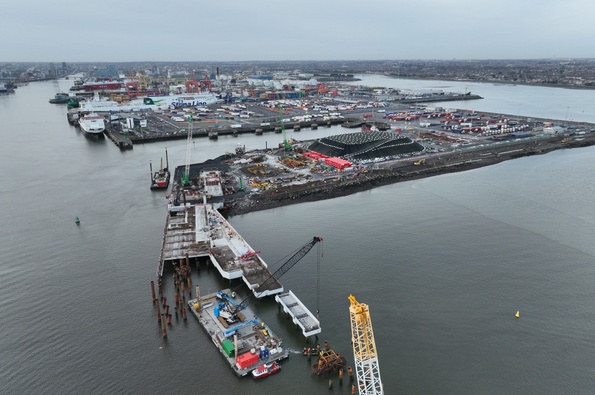
Image: Overview of construction works at B52 East and B53. Credit: Dublin port
Every stage, from dredging to design, has been shaped by data, discipline, and close coordination, showing that large-scale infrastructure can progress responsibly in a sensitive setting.
At Dublin Port, space is running out, but demand keeps growing. Under its Masterplan 2040, the port is expanding within its existing footprint through the MP2 Project, and the new Berth 53 development is a central part of that next phase. The roll-on/roll-off berth will handle larger vessels and rising freight volumes while sitting beside one of Ireland’s most environmentally-sensitive marine zones.
Delivering that balance between growth and protection has required some of the port’s most precise dredging and marine engineering to date, which, in turn, has shaped nearly every design decision.
Design challenges and environmental innovation
Located beside the 19th-century North Wall breakwater and within reach of a Special Protection Area (SPA), the Berth 53 site required tight control over sediment movement and tidal flow. To achieve this, Dublin Port Company, Wills Bros, and the project’s design consultants, Malachy Walsh & Partners and RPS, relied on hydrodynamic and ecological modelling to guide everything from foundation piling to the berth’s open-piled structure and innovative propeller screen.
Designing and constructing Berth 53 pushed Dublin Port’s engineers to work within tight physical and environmental margins; any alteration to seabed levels or water movement risked disturbing those ecosystems.
Speaking to CEDA Industry News, Máiréad Rushe, Project Manager at Dublin Port Company (DPC), which is responsible for developing, maintaining, and managing the port’s infrastructure, said, “We knew we couldn’t affect the SPA - not positively or negatively, it had to keep flowing as it always has.”
To avoid disturbing the environment, the design team adopted an open-piled jetty with interlinked dolphins, allowing natural tidal flow to continue beneath the structure. Also speaking to CEDA industry news, Tom O’Dwyer, Project Manager at Dublin Port Company, explained, “Because of the location and the flows between the rivers Tolka and the Liffey, it had to be an open piled structure, to keep the exchange going.”
Monitoring and environmental licensing conditions were put in place to ensure compliance with thresholds for suspended sediment and water quality. Hydrodynamic and ecological modelling guided the layout and assessed potential effects on water movement and sediment behaviour.
To reduce propeller wash and scour risk, a nine-metre underwater environmental screen will form part of the jetty structure, helping diffuse thrust energy and protect the adjacent intertidal habitats, a measure rarely seen in Irish port infrastructure.
“Smart” design and technology
The project brings together several firsts for Dublin Port - from an automated mooring system to a double-tier linkspan and a submerged propeller screen - each designed to improve safety, efficiency, and environmental performance.
The (AMS) Automated Mooring System replaces traditional ropes with vacuum-based units that secure vessels at the press of a button. For port operators, it reduces manual handling and allows ships to berth and depart more quickly, cutting turnaround time and limiting engine use during mooring. Rushe explained, “Safety and emissions were the big drivers - fewer people on the quay wall, and less time with engines running. It makes a huge difference operationally.”
The double-tier linkspan - a steel structure providing upper and lower deck access - allows flexible loading and discharge across varying tidal conditions, ensuring the berth can serve a wide range of roll-on/roll-off vessels. O’Dwyer explained, “The design was to accommodate a wide range of roll-on/roll-off vessels, from smaller ships to the largest ferries, across the full tidal range.”
Below the surface, the propeller screen plays a dual role: protecting sensitive habitats while regulating water flow between the berth pocket and the SPA. Taken together, these design features show how modern port infrastructure can integrate advanced engineering with environmental care.
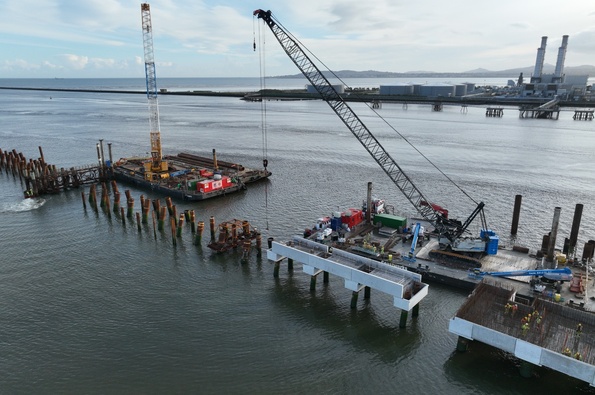
Image: Overview of construction works at B53 Credit: Dublin Port
Dredging, construction, and collaboration
Windowed dredging periods and real-time turbidity controls ensure the work stays within licence conditions while maintaining safe access for shipping.
DPC, Wills Bros, and the project’s design consultants coordinate dredging and piling to minimise suspended material and reduce vessel disruption. According to Rushe, “We have to work together across all the different areas - environmental, design, construction - from the very start.”
O’Dwyer said the construction process relies on constant feedback from the field: “Survey, design, adjust, we were always responding to live data.” The result is a marine construction programme delivered inside a complex tidal and regulatory environment, where every move balances efficiency, safety, and environmental care.
The road ahead
As the wider MP2 Project continues, early integration of engineering and environmental planning, tighter management of dredging windows, and built-in mitigation features are now seen as baseline practice rather than innovation. Rushe said the project’s approach is about building flexibility into port infrastructure - ensuring that what’s constructed today can support the technologies and operations of tomorrow. As Dublin Port moves toward wider decarbonisation goals, port electrification, the use of alternative fuels, and evolving regulations, Berth 53 provides a foundation for adapting to future needs.
Looking ahead, with the construction of Berth 53 due for completion in 2027 as part of the ongoing MP2 Project, the work already demonstrates how capacity growth and environmental stewardship can move in tandem when planning, design, and dredging are treated as a single process.
While the advice given in this editorial content has been developed using the best information available, it is intended purely as guidance to be used at the user’s own risk. No responsibility is accepted by CEDA or by the Intent Communications Ltd or by any person, firm, corporation or organisation who or which has been in any way concerned with the furnishing of information or data, the compilation, publication or any translation, supply or sale of this Guidance for the accuracy of any information or advice given herein or for any omission herefrom or from any consequences whatsoever resulting directly or indirectly from compliance with or adoption of guidance contained therein even if caused by a failure to exercise reasonable care.