Restoring the North Sea's lost ecosystem
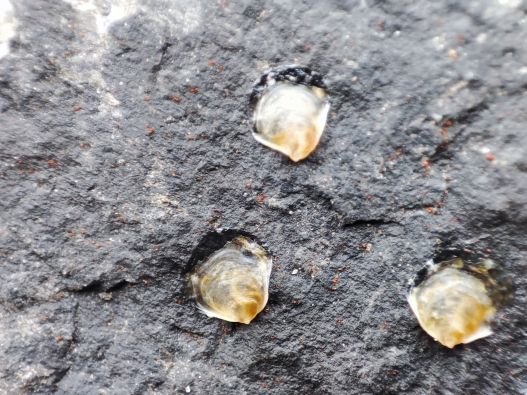
Close-up of oyster spat on rock, which are several weeks old (Photo Credit: Wouter van Broekhoven, Senior Marine Ecologist at Van Oord)
The native European flat oyster reefs of the North Sea, once abundant, have been destroyed by historic fishing practices, disease, and pollution, dramatically reducing marine biodiversity. Reversing this environmental harm demands an innovative approach. Now, a consortium is spearheading a collaborative effort to restore this vital ecosystem, embracing the innovative remote setting method, which involves cultivating millions of oyster larvae in a dedicated hatchery before transferring them to harbours or other locations close to the sea.
The North Sea once boasted vast oyster reefs that provided habitats for countless species. Today, these native European flat oysters are functionally extinct, primarily due to historical oyster fishing dating back at least to the 19th century. This loss has transformed the seabed from a diverse reef ecosystem into a sandy, less biodiverse environment.
The project draws on the expertise of the nine consortium partners: Wageningen Marine Research, Wageningen University & Research, ARK Rewilding Nederland, Stichting Zeeschelp, Waardenburg Ecology, Van Oord Ocean Health, TenneT, Port of Rotterdam Authority and The Rich North Sea. This collaborative effort focuses on reversing the decline of North Sea oysters. It is not merely about bringing back a single species; it is about restoring the entire reef habitat and increasing the North Sea’s overall biodiversity and resilience against climate change.
The remote setting innovation
In recent years, several successful oyster restoration pilots have been implemented. But these were often based on relocation of adult oysters, which needed to be individually handled and is a labour-intensive process. Speaking to CEDA Industry News, Wouter van Broekhoven, Senior Marine Ecologist at Van Oord, explained that remote setting offers a more scalable alternative. “The remote setting process begins with the production of millions of oyster larvae in an oyster hatchery, which are then allowed to set on rock by themselves,” explained van Broekhoven.
Larvae are introduced into a specialised, modular, container-based facility in the port, where they are allowed to settle and attach to the rock. Once settled, the larvae are known as ‘spat’, and the product as ‘spat-on-rock’.
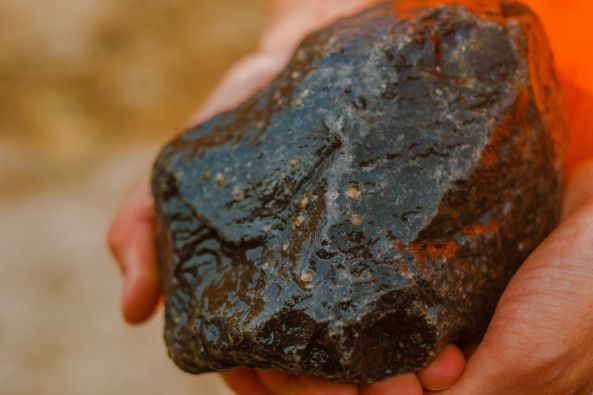
Stones covered with juvenile oysters or ‘spat-on-rock. (Photo credit: Lex Bezemer, Port of Rotterdam)
Rock is an ideal choice because it is stable, naturally occurring in the North Sea, and easy to procure and handle. Once covered in tiny oysters, these rocks are deployed in mass quantities to form new reef patches. This modular, container-based approach is designed for easy scale-up and replication, making it an efficient alternative to the existing and more labour-intensive restoration techniques.
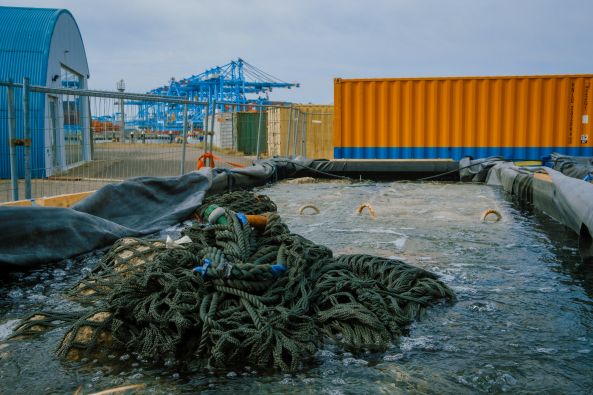
REmote Setting flat Oyster (RESO) setup in the harbour ot Rotterdam (Photo credit: Lex Bezemer, Port of Rotterdam)
A multi-phased, collaborative pilot
The project was structured in distinct phases to test and prove the concept. The initial focus in year one, at the Port of Rotterdam, was to establish the remote setting facility and successfully produce and outplace spat-on-rock. “The Port of Rotterdam was chosen for this first placement due to its sheltered basins, which offer an intermediate, controlled environment for the spats to grow before being exposed to the open sea,” explained Rinske van de Meer, Policy Advisor at the Port of Rotterdam Authority, to CIN.
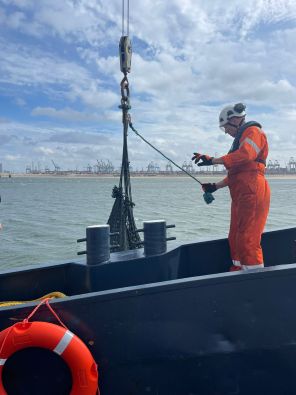
Outplacement of spat-on-rock at the Port of Rotterdam (Photo Credit: Wouter van Broekhoven, Senior Marine Ecologist at Van Oord)
The subsequent phase, in year two, will involve applying the learnings from the first year and deploying the spat at the offshore cable crossing of TenneT. This location is ideal because the intersection of the cables is higher than the surrounding seabed and is protected by existing rock armour, offering a stable and elevated substrate that avoids the smothering effects of seabed sediment.
Future implications
“Ultimately, this project is a vital step towards recreating the vast, interconnected network of oyster populations that once thrived in the North Sea, proving that with innovation and committed partnership, we can heal and enrich our marine ecosystems,” said van Broekhoven.
“This project is not merely an isolated ecological study; it represents a paradigm shift in how we approach maritime infrastructure as a vehicle for large-scale marine restoration,” he further explained. Restored oyster reefs are also an effective strategy to prevent coastal erosion. The initial success in achieving dense settlement of European flat oyster larvae serves as compelling proof of concept. This breakthrough demonstrates that targeted innovation can overcome significant biological hurdles. More critically, the project is moving beyond anecdotal success by meticulously quantifying the success rate, providing the essential baseline data for true scalability.
By developing the most efficient deployment methods, the project is creating a replicable blueprint for restoring the North Sea's vast oyster populations, “transforming ambitious conservation goals into achievable, measurable objectives,” said van de Meer. For example, Clarion is a European grant project funded by the Horizon Europe Programme. One of its pilots will be conducted to see whether the shellfish (particularly flat oysters) can fulfil a hydraulic engineering function, by strengthening toe protection or slopes. The oyster-covered rocks will be used within this pilot as well.
The project champions a nature-inclusive approach to essential infrastructure development. It reframes elements often seen as environmental liabilities, such as cable crossings and port defences, into opportunities for ecological enhancement. Coupled with bio-acoustics research, which is testing whether the sounds of a healthy reef can act as an auditory beacon for larvae, this project is demonstrating a commitment to maximising efficiency. This integrated approach, leveraging both biological innovation and existing physical infrastructure, establishes a pathway to responsible, future-proof industrial development.
The development of an easily transportable, remote setting technique provides a global template for marine restoration. This capacity to conduct the setting process near any deployment site significantly lowers logistical barriers, making it a highly replicable model for restoring reef-building oysters in diverse coastal and offshore environments worldwide. “This collaborative effort proves that with committed cross-sectoral partnership, we possess the ingenuity and capability not just to halt decline, but to actively heal and enrich our global marine ecosystems, laying the groundwork for a richer, more resilient blue economy,” said van de Meer.
While the advice given in this editorial content has been developed using the best information available, it is intended purely as guidance to be used at the user’s own risk. No responsibility is accepted by CEDA or by the Intent Communications Ltd or by any person, firm, corporation or organisation who or which has been in any way concerned with the furnishing of information or data, the compilation, publication or any translation, supply or sale of this Guidance for the accuracy of any information or advice given herein or for any omission herefrom or from any consequences whatsoever resulting directly or indirectly from compliance with or adoption of guidance contained therein even if caused by a failure to exercise reasonable care.