A race to the finish line
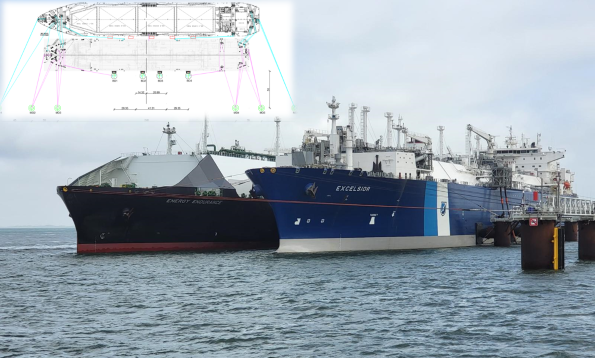
Mooring of Wilhelmshaven-2 Floating Storage Regasification Unit and LNGC with mooring arrangement drawing (Copyright: IMDC)
In the wake of increased geopolitical tensions, Europe's energy map is being redrawn. This transformation is more visible in the North Sea, where the construction of the Wilhelmshaven-2 Floating Storage Regasification Unit (FSRU) terminal aims to bolster Germany’s energy security.
The Wilhelmshaven-2 project, spearheaded by Deutsche Energy Terminal GmbH (DET) with partners ENGIE and Tree Energy Solutions (TES), was designated a priority under Germany’s LNG Acceleration law, passed in May 2022. The objective was clear: create an independent maritime gateway capable of bringing Liquefied Natural Gas (LNG) into the country via global tankers, independent of origin, reducing reliance on single-source pipeline gas while fortifying the country against future supply shocks.
The location of the Wilhelmshaven-2 terminal, an island jetty situated approximately 1.8 kilometres from the mainland, is strategically advantageous, classifying the site as a deep-water port capable of handling large LNG carriers regardless of the tide.
With an expected annual grid injection capacity of up to 4.6 billion cubic meters, the terminal is poised to cover a significant percentage of Germany’s gas demand, supplying heating for nearly four million households. However, achieving this goal was not just a matter of political will; it required specialised expertise from IMDC as designers and owner’s engineer (OE), as well as international marine contractors Van Oord and Jan De Nul, working under pressure to meet tight deadlines and against formidable natural challenges.
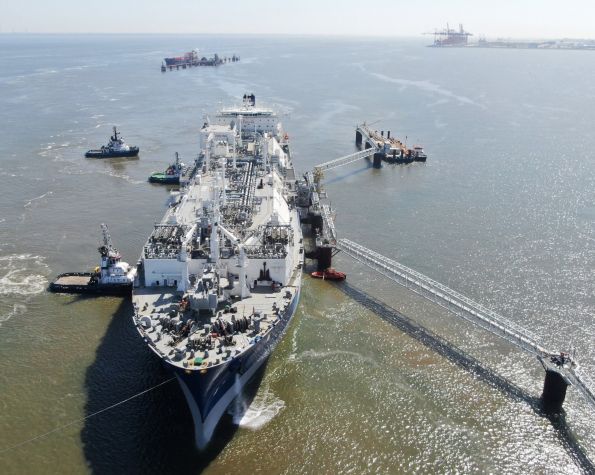
Aerial view of FSRU berthing against Jetty (Copyright: IMDC)
A collaborative effort
Project deliverables were meticulously planned and allocated across multiple contractors.
IMDC was appointed by ENGIE to act as Designer and Owner’s Engineer (OE) for the entire marine scope. Speaking to CEDA Industry News (CIN), Pierre Roux, Senior Engineer, IMDC, explains, “Our role was one of deep technical support and verification, ensuring that the design and construction were compliant and robust enough to withstand the demanding local environment. IMDC’s remit was expansive, covering everything from detailed jetty design – including dynamic mooring analysis and scour protection design – to extensive permitting assistance.” This involved advanced numerical modelling to predict and assess the environmental impacts of the jetty, including sedimentation, thermal dispersion, and underwater noise. They also managed the tendering process, developed construction and installation methodologies, and provided crucial site supervision and quality control throughout the build.
Van Oord, appointed by ENGIE on a procurement, fabrication, transport and installation contract – which included the procurement and supply of all jetty elements – was responsible for the marine construction.
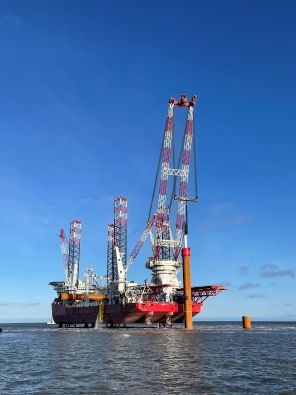
Monopile pile driving installation activity with double bubble curtain (Copyright: IMDC)
In 2024, Van Oord installed ten monopiles, complete with scour protection to guard against erosion. These foundations were then fitted with platforms, catwalks, and essential jetty furniture. To prepare the site, Van Oord’s trailing suction hopper dredger, the Vox Apolonia – running on the more sustainable Liquefied Natural Gas (LNG) – was deployed to dredge the berth pocket and turning basin to the required operational depth.
Stan Aarts, Project Director at Van Oord, speaking to CIN, says, “We developed and implemented a unique construction concept that was critical to meeting the aggressive deadline: utilising large monopiles instead of numerous individual piles, combined with prefabricated steel structures.”
The terminal developer was a partnership between Engie and TES. Econnect was a subcontractor of TES, which in turn acquired the services of Geocean, which subcontracted Jan De Nul. They were responsible for executing the critical trenching works for the subsea pipelines and pipeline end manifolds (PLEMs). As Servaas Waelkens, Seabed Interventions, Jan De Nul explains to CIN, “Jan De Nul's early involvement in the engineering phase proved vital, allowing our team to collaboratively define a trench design that was feasible with their equipment, leading to the most effective execution of the works.”
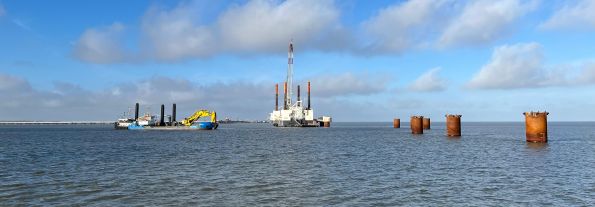
Overview of the project site with simultaneous dredging operations by BHD Vitruvius, and installation activities by JB-119 (Copyright: Jan De Nul)
During the dredging operations for the footprint of the future PLEM locations, Jan De Nul’s backhoe dredger, Vitruvius, had to work very close to the monopiles of the offshore jetty. Furthermore, they had to position their dredger in such a way that its spuds would not disturb the flat surface that was required for the PLEM installation. This would not have been possible without the good communication and exchange of required up-to-date information, as was maintained throughout the project execution period.
Battling the elements
The prime location of the Wilhelmshaven-2 project also experiences one of Europe’s strongest tidal currents, posing severe constraints on construction and operations.
“Starting with geotechnical investigations and UXO clearance, and continuing through the installation of the first monopile, the local environment dictated the pace of work,” explains Pierre Roux. The construction of large jetty elements required jack-up vessels and barges, where any delay due to high currents meant costly downtime. Later, the installation of the main floating pontoon – the formal access point – had to be precisely timed during the short period between the change of the tides.
For Jan De Nul, the currents were particularly challenging, flowing perpendicular to the required trench. “Our backhoe dredger, even when stabilised with spuds, required tugboat assistance for every position shift. This forced our operational superintendents to constantly adapt their strategy, leveraging the current to push split hopper barges safely alongside the dredger for disposal – an intricate manoeuvre that had to be performed on either side of the dredger depending on the current direction,” explains Waelkens.
Compounding the challenge was the harsh North Sea winter. The schedule restraints meant construction had to proceed during the harshest months of the year, facing what is locally known as the windy city conditions. High winds frequently grounded crew changes or forced vessels to seek shelter. “The tidal difference added complexity. The solution was the extensive use of Jack Up Barges for all platform installation, welding, and outfitting tasks, ensuring that work could proceed irrespective of the water level,” explains Aarts. For critical welding operations, special climate-controlled structures had to be constructed on the exposed jetty to maintain the necessary environment for pre-heating and welding works.
Lessons for future projects
The major challenge for all parties was the ambitious timeline. “The fast-track nature meant that design and construction were running in parallel,” says Roux. Procurement and fabrication often had to begin before certain design aspects were finalised and approved, requiring agility. “The project goal was always to have as many jetty elements completed onshore, thus reducing the offshore time for installation, welding, and coating,” he adds.
For Jan De Nul, an initial plan to sidecast dredged material to create a channel for the backhoe dredger and barges had to be abandoned because the strong current required a channel too wide for the unstable soil to support. This confirmed that the operational strategy must be adapted project-by-project based on the unique characteristics of the location. “This project underlined that a 'floatation channel' is not defined purely by vessel geometry, but fundamentally by site conditions,” explains Waelkens.
Ultimately, the success of Wilhelmshaven-2 is a powerful showcase for international marine contractors. It provides a foundational reference for IMDC, Van Oord, and Jan De Nul to market themselves as reliable parties with a track record of delivering complex, time-critical projects under challenging environmental conditions, reflecting a shared ‘one-team’ mentality.
More profoundly, the Wilhelmshaven-2 terminal has cemented Germany's role in bolstering Europe's energy resilience, transitioning to a robust, flexible energy hub capable of weathering global instability.
While the advice given in this editorial content has been developed using the best information available, it is intended purely as guidance to be used at the user’s own risk. No responsibility is accepted by CEDA or by the Intent Communications Ltd or by any person, firm, corporation or organisation who or which has been in any way concerned with the furnishing of information or data, the compilation, publication or any translation, supply or sale of this Guidance for the accuracy of any information or advice given herein or for any omission herefrom or from any consequences whatsoever resulting directly or indirectly from compliance with or adoption of guidance contained therein even if caused by a failure to exercise reasonable care.