Dredging: a vital service for the energy transition at Ardersier
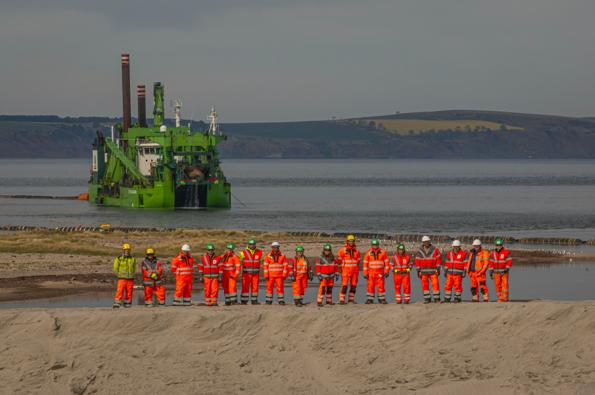
DEME project team (Credit: DEME and Haventus)
The Ardersier Energy Transition Facility on the Moray Firth is being developed as a deep-water port and laydown site to support offshore wind deployment. It is positioned as one of the largest facilities on the North Sea coast for deploying and servicing offshore wind installations, with a focus on Scotland's net-zero target by 2045. The facility will support the entire offshore wind supply chain, offering extensive land, close proximity to major wind farms, and deep-water access.
The facility opened in 2025, with future expansion plans set to take the site to approximately 500 acres. The project is underpinned by a £300 million equity investment commitment from US-based energy investment firm Quantum Energy Partners, alongside a £100 million joint credit facility agreed in 2024 with the Scottish National Investment Bank and the National Wealth Fund (previously the UK Infrastructure Bank). Together, this funding supports the repurposing of the former oil and gas fabrication yard to handle large-scale renewables infrastructure.
Extensive dredging and reclamation works are central to enabling the redevelopment. DEME delivered nearly four million m³ of dredging, partially reclaimed onshore, to create new deep-water access, a basin and large areas of reclaimed land. These groundworks provide the depth and space required for turbine assembly, marshalling and installation activities.
DEME conducted these works in a constrained coastal environment, near marine mammal habitats within the Moray Firth, and alongside ongoing onshore construction. At Ardersier, dredging is a critical component of the site’s redevelopment, illustrating how marine construction underpins new infrastructure for the UK’s energy transition.
Project scope and technical demands
The marine works involve cutting into a heavily infilled former basin and approach channel, where sediment layers reach up to 12 metres in thickness. Initial water depths were extremely limited, creating access constraints that ruled out the use of trailing suction hopper dredgers at the start of the programme.
To address these conditions, the works were led by a cutter suction dredger (CSD), selected for its ability to operate in shallow water and cut its way into compacted material. Speaking to CEDA Industry News, Thomas Vervoort, Area Manager of UK & Ireland at DEME, explained that dredger choice was dictated by site access rather than capacity. “A hopper could simply not go on top of it, at the beginning,” he said. “Because of the shallow depth, you needed a cutter suction dredger to really dredge its way inside.”
As excavation progressed and access depths increased, the dredging spread was expanded to include trailing suction hopper dredgers and self-propelled split hopper barges, allowing material transport and placement methods to evolve in parallel with the works. This phased approach required careful coordination between dredging, reclamation and disposal activities to maintain continuity across the programme.
Tight geometric tolerances were applied across the basin and channel works, with final depths and widths needing to align precisely with future heavy-lift and installation requirements. Delivering within these parameters and restricted access conditions placed a premium on detailed survey control, sequencing and daily operational planning.
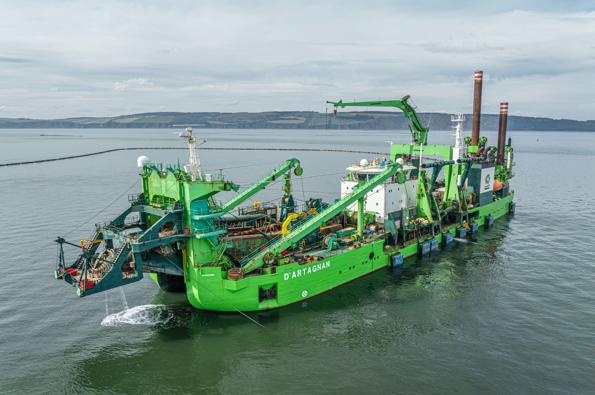
DEME’s main production unit, Cutter Suction Dredger D’Artagnan (Credit: DEME and Haventus)
Quality, health, safety and environmental (QHSE) challenges
Environmental monitoring at Ardersier was embedded directly into dredging operations rather than treated as a parallel activity. A marine mammal observer (MMO) was stationed on board the cutter suction dredger, supported by passive acoustic monitoring, allowing dredging activity to be adjusted immediately if protected species were detected.
Tidal conditions placed further constraints on how and when equipment could operate. Restricted working windows influenced vessel movements, survey schedules and dredging sequences, requiring continuous coordination between marine crews and project management to maintain progress without compromising safety or environmental controls.
The works were also delivered within a simultaneous operations (SIMOPS) environment, with dredging taking place alongside reclamation activities and onshore construction. Managing interfaces between multiple contractors and vessel movements within a confined working area required structured daily planning, defined exclusion zones and clear lines of responsibility across marine and land-based teams.
According to Vervoort, these overlapping considerations required environmental and safety controls to shape day-to-day decision-making on the water, rather than being applied as static requirements. Maintaining visibility across all activities was critical to managing risk, with conditions and access changing throughout the programme.
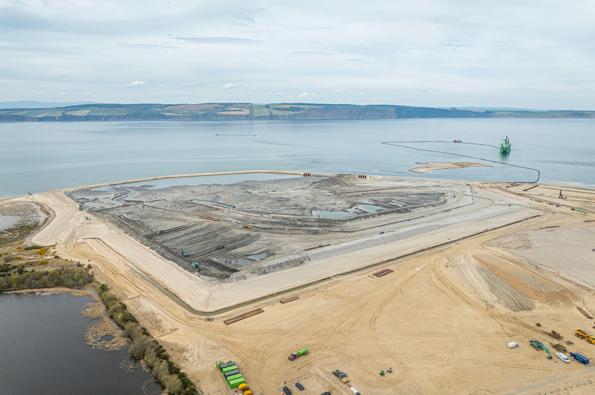
Onshore reclamation works within the Port of Ardersier (Credit: DEME and Haventus)
Strategic significance
The redevelopment of Ardersier reflects wider pressures facing ports seeking to support offshore wind deployment at scale. As turbine sizes increase and installation schedules tighten, ports must provide sufficient depth and contiguous laydown space within increasingly short delivery timeframes. Meeting those requirements is now a prerequisite for participation in the offshore wind supply chain.
Dredging has been a decisive factor in enabling the site to compete for this role. By re-establishing marine access and creating the physical conditions required for heavy-lift operations, the works have repositioned a formerly constrained, brownfield site for a new industrial purpose. This shift highlights how dredging capacity and sequencing can directly influence whether legacy port infrastructure can be adapted quickly enough to meet emerging energy demands.
The project also underlines the growing interdependence between marine construction and energy transition planning. As offshore wind programmes accelerate, the availability of dredging plant, marine expertise, and supporting infrastructure is becoming a strategic consideration. This integration shows how dredging is shaping how ports respond to structural shifts in energy infrastructure, managing delivery risk and the pace at which new capacity can be brought online.
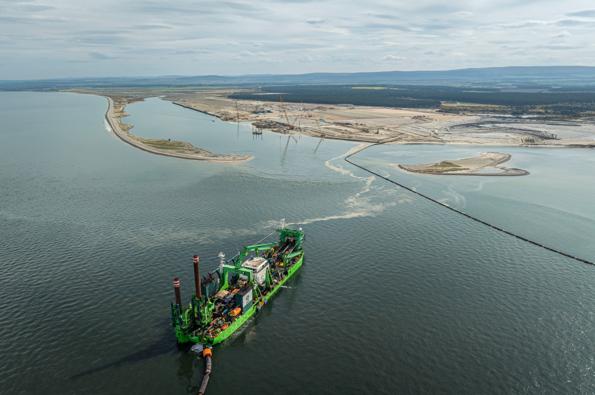
Ardersier port (Credit: DEME and Haventus)
Shaping port readiness
As competition intensifies between ports seeking roles in offshore wind supply chains, delivery timelines and readiness are increasingly important. Vervoort described the wider landscape as “a race between ports to be the frontrunner in order to accommodate the wind farms”. At Ardersier, the completion of the marine works has positioned the facility to compete within that landscape.
While the advice given in this editorial content has been developed using the best information available, it is intended purely as guidance to be used at the user’s own risk. No responsibility is accepted by CEDA or by the Intent Communications Ltd or by any person, firm, corporation or organisation who or which has been in any way concerned with the furnishing of information or data, the compilation, publication or any translation, supply or sale of this Guidance for the accuracy of any information or advice given herein or for any omission herefrom or from any consequences whatsoever resulting directly or indirectly from compliance with or adoption of guidance contained therein even if caused by a failure to exercise reasonable care.