Retrofitting automation in dredging
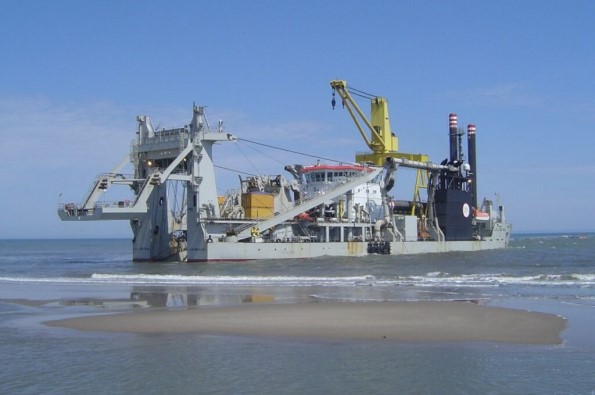
Automated systems are commonplace on newbuild dredgers as owners and clients use modern technologies to get the best operational results, but this progress towards more capable and efficient vessels is not reserved for dredgers freshly delivered from the yard.
Older dredgers are increasingly being retrofitted with automated systems to reap the benefits of cutting edge technologies and stay competitive in the market. “The market demand for retrofits with modern technology is about as big as the dredging fleet as constructed the last 25 years,” Riny Mourik, Sales Manager, IHC Digital Business Systems told CEDA Industry News.
Beyond the headline battle for speed and efficiency in operations, the capabilities at the top end of the dredging market bring more stringent contract conditions that may be beyond the reach of an older ship unless upgrades are made.
Automation drivers
Mourik pointed out that while dredgers are among the longest-serving vessels in the maritime industry, with typical operational lifespans of 30 to 40 years, the electronics on board typically only last for between seven and 10 years before spare parts become harder to find and repair security fades away.
As well as becoming harder to maintain over time, electronic equipment for dregers becomes obsolete and outdated as newer and more sophisticated systems are released. Just as the phone in your pocket is outshone year over year as newer models hit the market, both hardware and software on board a dredger can be overshadowed by new
developments in technology. “This translates on average to at least one retrofit in the lifetime of the dredger, and sometimes even three retrofits,” he said.
A second driver for retrofits is tightening dredge contract conditions. As client requirements around measurements and data logging increase, active cutter and hopper dredgers often require upgrades to ensure that contract conditions are reliably met and data accurately recorded and reported.
Life extension
Although expensive, retrofits are a vital investment for operators looking to stay competitive. Jan De Nul Group’s cutter suction dredger (CSD) J.F.J. De Nul was built in 2003 and is among the largest and most powerful CSD on the water. Royal IHC built the vessel and won the contract for an automation retrofit 10 years later in January 2023. At 10 years old, the ongoing upgrade of J.F.J. De Nul requires the replacement of SCADA hardware and software, PLC processor hardware, and networks on the vessel, all of which became outdated. Both owner and shipbuilder are aware that come 2033, another round of upgrades will likely be due.
As automation updates, upgrades and retrofits become more common and necessary, the tasks become a routine part of fleet maintenance. Instead of one-off projects and capital investments, retrofit programmes and schedules are an important part of fleet management and fleet planning.
Operational benefits
Automated control of dredging equipment can bring improvements in operational efficiency by turning real time data into optimised adjustments to parameters like depth and speed which save time and cut fuel costs. Beyond improved efficiency, the data collection and analysis element of automation can help to protect marine environments. Real-time processing of sensor data on sediment types, water quality, and other environmental factors can be used to detect sensitive marine ecosystems and automatically adjust operations to avoid and minimise any impact on that area. Sediment plumes can also be reduced near sensitive areas to protect marine ecosystems and habitats.
Through the use of fail-safes and alerting systems, automation can also have a positive impact on safety, taking pre-determined corrective action in the event of equipment failure, malfunction, or an unexpected obstacle to the machinery. However, it is vital that operators ensure that the automation functionality remains online to maximise use, which is why redundancy is a key automation component.
As part of the recent lengthening of the Boskalis trailing suction hopper dredger Oranje at Keppel Shipyard in Singapore, a new E-series Mega-Guard system was installed using a redundant 100 Mbps backbone ethernet
connection to boost communication capabilities. The installation allowed the new E-Series to move beyond the range limitations of the CAN network technology that the previous iteration relied upon.
In-demand technologies
Customers seeking dredging automation technologies are looking for specific improvements in vessel and equipment performance, all of which tend to fall under the umbrella of enhancing dredging efficiency. While there may not be a silver bullet for every vessel, even small improvements can yield impressive results over time. For example, automated pump and positioning systems, and dynamically-controlled production of dredged material can
save both fuel and time.
That said, technology does offer new functionality. Dredger owners can now purchase systems that measure the exact location of the dredging work being done, with a minimum accuracy of 10cm, along with monitoring systems to ensure the work continues to be performed where it should be. Greater accuracy and reporting capabilities can translate into access to more contracts, time savings, and ultimately commercial gains.
Future developments
The process of retrofitting automation systems to a dredger is much easier and cost effective when a dredger is designed with automation in mind. While solutions may be found or devised for less prepared vessels, the project may prove uneconomical if the basics are not in place. Operators should also stay abreast of technological developments on the horizon.
Shandong Haohai Dredging Equipment Co. Ltd (HID Dredging) recently stated its commitment to research and development in areas leveraging automation and operational streamlining in dredging, and Royal IHC is continuing to work with industry professionals on the development of its modular Mission Master automation product. Elsewhere in the maritime industry vast sums of money are being invested in vessel control, route optimisation, and vessel efficiency technologies to meet the future demands of the industry. Furthermore, maritime connectivity is increasing with more bandwidth and lower latency specifically targeted at enabling data-intensive efficiency improvements.
No doubt automation of both the vessels and their processes will continue to be refined in coming years, spurred by increasingly stringent environmental regulations and sustainability aims. Understanding and investing in automation technologies will likely provide canny dredger owners a competitive advantage, with implications for the existing fleet as well as newbuild orders.
CEDA’s Technical Papers Committee is inviting abstracts for presentations at Dredging
Days 2024, including on the topic of Dredging Process Automation. For further information
on the conference programme and how to submit an abstract to the Technical Papers
Committee visit: www.cedaconferences.org/dredgingdays2024
While the advice given in this editorial content has been developed using the best information available, it is intended purely as guidance to be used at the user’s own risk. No responsibility is accepted by CEDA or by the Intent Communications Ltd or by any person, firm, corporation or organisation who or which has been in any way concerned with the furnishing of information or data, the compilation, publication or any translation, supply or sale of this Guidance for the accuracy of any information or advice given herein or for any omission herefrom or from any consequences whatsoever resulting directly or indirectly from compliance with or adoption of guidance contained therein even if caused by a failure to exercise reasonable care.