Borusan port: A dredging success story
Not a member yet? Learn about the benefits of membership
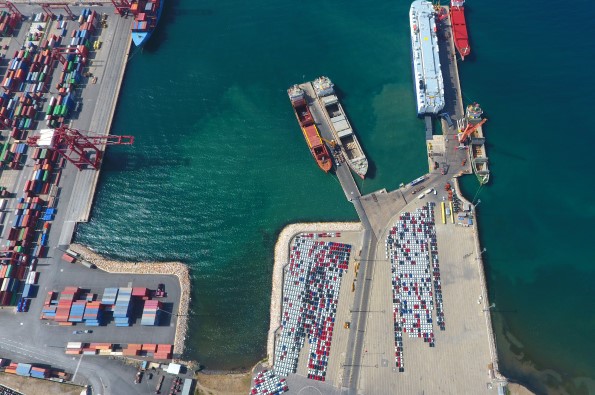
In October 2023, the European Bank for Reconstruction and Development (EBRD) approved a senior loan of up to USD 33.2 million (EUR 29.5 million) to Borusan Logistics, operators of Borusan port, as part of the EBRD’s strategy to promote sustainable infrastructure and green economy transition in Türkiye. In addition to a new warehouse and the procurement of heavy-duty port equipment, the loan will be used to help fund the construction of a new pier, as well as associated dredging of the port basin, access channel and the new berths to accommodate larger vessels.
East Terminal Modification project
Borusan port is a mixed-use port which handles a variety of cargo, including vehicles, containers, and general cargoes and was one of the first ports in Türkiye to receive the Green/Eco Port Certificate. Supporting a slew of businesses, including the local automotive, steel, textile and mining industries, the port is a key transit hub for the Southern Marmara Region, one of Türkiye’s most dynamic industrial centres.
But a successful port never rests on its laurels and Boursan Logistics has an ambitious plan to not only expand the port, but also to accelerate its digitalisation and renew its logistics fleet and provide new employment opportunities for the local community. While the EBRD loan has yet to be formally signed (as of mid-November 2023), the East Terminal Modification project, which started in September this year and is due for completion in December 2024, is expected to enhance the port’s operational efficiency, competitiveness, and environmental performance, as well as support the company’s growth strategy.
Aydin Basar, Borusan Logistics’ CFO, told CEDA Industry News the schedule of work includes the demolition and removal of an existing pier measuring 2,475 square metres, construction of a new General Cargo pier built upon 220 steel piles with lengths ranging from 69-72m, and the removal of approximately 202,000 cubic metres of sediment to create a dredged depth of between 12.50-14.50m along the new pier. Basar also explained that a new approach road bridge will be constructed, underpinned by 1320/22-20mm steel piles.
Project implementation is being carried out in accordance with the project principles approved by Türkiye’s General Directorate of Infrastructure Investments. Land excavators mounted on barges are undertaking the bulk of the dredging works and material recovered from the seabed is being transported, by barge, to designated disposal sites 47 miles away from the port. The disposal sites were carefully selected by the competent authorities to avoid sensitive habitats and minimise environmental impact, and all works are being undertaken in accordance with an approved environmental impact assessment (EIA).
Upon commissioning, the new pier will be equipped to provide services to General Cargo ships with a capacity of 70,000 DWT. As Basar highlighted to CEDA Industry News, “the extension will increase the port’s capacity by around 20%, providing further employment possibilities to the local neighbourhood.”
Environmental considerations
According to EBRD’s project summary document, the Environmental and Social Due Diligence ("ESDD") study was performed by an independent consultant and included an assessment of the impact of the proposed dredging works. The study concluded that, “the pollutants concentration in the dredging material are well below the nationally established norms for the Marmara Sea region and are in line with international standards.”
However, it did stress that the disposal of the dredged material might impact on the livelihoods of fishermen, depending on its exact location in the Marmara Sea. Hence Borusan Logistics was required to develop a dredging management plan as part of a comprehensive Environmental and Social Management Plan (ESMP) and Environmental and Social Action Plan (ESAP). To address an EBRD stipulation, the ESAP included, “a commitment to conducting a specific fisheries impact assessment when the dumping area is approved and an assessment of the need for a livelihood restoration plan”. As a consequence, disposal activities have been carefully managed to avoid spawning and breeding seasons.
Complex challenges
The dredging works require the removal of approximately 202,000 cubic metres of material, consisting of clay, silt, sand, and gravel, and the dredged material has to be disposed of without affecting water quality, marine life, or coastal erosion.
To complicate matters, Borusan port is located near the North Anatolian Fault, a right lateral strike-slip fault, which is regarded as one of the most active fault zones in the world. Carrying out dredging works in a highly seismic area means the risk of liquefaction and slope instability is high and, as a consequence, all port works must comply with the provisions of the revised 2018 earthquake code. Strong currents and waves, which pose difficulties for dredging operations and equipment, further exacerbate the challenging local conditions.
The solution
Fortunately, the port has gained much experience during previous phases of its development and expansion programme, which included dredging, reclamation, and construction of new facilities to increase the port’s capacity and efficiency. To overcome the myriad challenges, Borusan Port hired 2ER, a local engineering and consulting firm, to provide structural, geo-technical, and seismic design engineering services for the new pier and project management services for the dredging works. Using a combination of numerical modelling, field investigations, and laboratory testing, 2ER optimised the dredging design and methodology to ensure compliance with relevant regulations and standards.
The dredging works are being carried out using a trailing suction hopper dredger (TSHD) to dredge softer material in the port basin and the access channel, and a backhoe dredger to dredge the harder material near the pier and the shore. Working closely with the dredging contractor, DGN, Borusan Logistics and 2ER continue to coordinate the dredging activities to ensure the safety and quality of the works.
The benefits
The dredging works, which will enable the new pier to safely handle larger vessels, commenced in September 2023 and are due to be completed in February 2024. Upon final project completion, in December 2024, the new pier and its deep berths will improve accessibility, operational efficiency and flexibility, reduce the risk of running aground, and reduce waiting times and the attendant costs for vessels and cargo owners.
Collectively, these gains will enhance the port’s competitiveness and make Borusan port more attractive for international trade. The wider importance of attracting new customers to the port is not lost on Borusan Logistics - greater commercial success will promote regional economic development, support local industries, and create new business and employment opportunities.
Learnings
The dredging works are adhering to the best practices and standards for dredging in Türkiye and demonstrate how such activities can be conducted in a sustainable and responsible manner, to minimise environmental impact and maximise social and economic benefits. The dredging works also showcase the technical expertise and innovation of the project team, which are allowing the complex and challenging conditions of the site to be overcome.
The port development work stands to further increase the port’s capacity and efficiency and secure its reputation as a major import and export node in the Marmara Sea. The redevelopment of Borusan Port, including the dredging works, is a success story that can inspire and inform other similar projects in the future. The project is a testament to the importance and value of dredging as a key component of port development and management.
While the advice given in this editorial content has been developed using the best information available, it is intended purely as guidance to be used at the user’s own risk. No responsibility is accepted by CEDA or by the Intent Communications Ltd or by any person, firm, corporation or organisation who or which has been in any way concerned with the furnishing of information or data, the compilation, publication or any translation, supply or sale of this Guidance for the accuracy of any information or advice given herein or for any omission herefrom or from any consequences whatsoever resulting directly or indirectly from compliance with or adoption of guidance contained therein even if caused by a failure to exercise reasonable care.