Rising to the EU MRV challenge – calls to combine good intentions with greater clarity
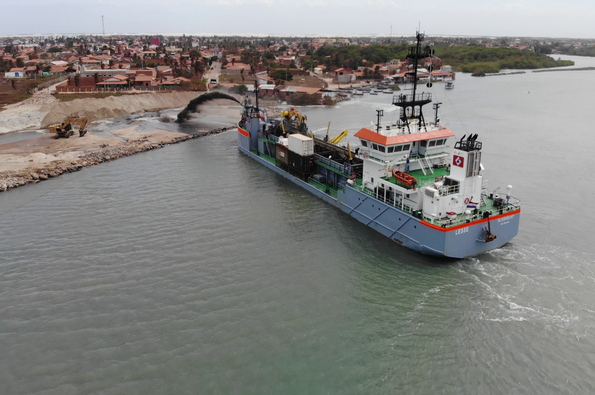
Dredger LESSE at Work (Credit: CEDA)
The EU Monitoring, Reporting and Verification (EU MRV) Maritime Regulation (Regulation (EU) 2015/757) was introduced to assess the maritime sector’s impact on climate change by mandating the collection and reporting of emissions data.
The MRV – which will enable the carbon tax determination that will form part of the EU Emissions Trading System (EU ETS) and FuelEU Maritime regulation – applies to vessels engaged in commercial transport of cargo or passengers when routes begin and/or end at ports within the European Economic Area (EEA).
In 2023, cargo and passenger ships of at least 5,000 gross tonnage were required to comply with the MRV. As of the beginning of January 2025, the revised MRV regulations additionally encompass general cargo and passenger ships between 400 and 5,000 gross tonnage, as well as offshore ships of at least 400 gross tonnage.
The inclusion of offshore ships resulted in significant administrative effort and costs for both large and small dredging companies. Larger companies typically own a wide range of vessel types, which requires additional administrative effort. Meanwhile, the expansion of the range down to 400 gross tonnage means smaller companies – that are less likely to be equipped with onboard monitoring equipment that automatically collects data – will also be affected.
Speaking to CEDA Industry News, Harold Slump, QHSE Coordinator, Dutch Dredging, explains: “At smaller dredging companies in particular, compliance with MRV does introduce significant extra work. There’s a clear case for automating as much of the data collection as possible but this will take time and introduce additional costs. For a smaller business, the process will typically involve using Microsoft Excel and logbooks, alongside exploring automated solutions."
Paul Vercruijsse, Chair of the CEDA Commission on Decarbonisation (CCD), also notes that the dredging industry is willing to comply with the MRV, but the proposed regulation does need improvement.
Speaking to CEDA Industry News, Vercruijsse explains: “Regulation will play a key role in realising the EU’s ambitions of achieving net zero emissions by or around 2050. At the same time, it’s important that regulation is devised with a close understanding of the realities of the industry. There is some progress to be made with the MRV to ensure it reflects how dredgers operate.”
Adapting regulation to reflect the realities of dredging
Andrea Caricato, Head of Sustainability, Rohde Nielsen, echoes the view that the MRV has not been devised with a full understanding of the dredging sector.
Speaking with CEDA Industry News, Caricato explains: “We welcome the push for greater transparency in recording emissions that the MRV aims to deliver, and ultimately we are committed to playing our part in driving the entire maritime sector to accelerate efforts to reduce emissions, which is in line with our strategic objectives and also with the International Maritime Organization’s aspirations. Our main concern is the regulation as it stands doesn’t fully reflect the realities of a business like ours, which is primarily engaged in dredging and marine construction activities and not traditional shipping.”
“The MRV framework currently appears to be tailored to conventional vessels, such as cargo ships, containers and passenger vessels, which travel from A to B, stopping to release passengers before heading off again,” adds Caricato.
Attempts to provide clarity
The EU has already responded to calls for greater clarity – offering more detail on how an ocean vessel is defined under the MRV through a list of ship types designed or certified to perform service activities offshore. Despite this, Caricato believes even further clarification will prove important, including additional focus on the specific operations of vessels, as opposed to simply vessel type.
“A more nuanced set of definitions would hone in on the operations associated with vessels. As things stand, we feel that businesses that are operating in the dredging and offshore industry might tend to behave quite conservatively and act according to the strictest possible interpretation of the regulations, which is why we believe greater clarity could prove valuable,” explains Caricato.
Net-Zero Framework pause – and the need for a level playing field
The recent one-year pause on the vote to adopt the IMO’s Net-Zero Framework has introduced a degree of uncertainty when it comes to establishing clear global guidelines aimed at reducing emissions. This pause, combined with the clarification required on MRV, risks posing particular challenges to dredging companies based and operating in the European Economic Area, explains Caricato.
“We certainly shouldn’t lose sight of the fact that this regulation is being introduced with the aim of achieving worthy environmental goals, while at the same time remaining mindful of the dangers of potentially placing European operators at a competitive disadvantage. It’s clear that establishing a global consensus has an important part to play in a more sustainable future in which there is also a level playing field,” adds Caricato.
Vercruijsse echoes the importance of creating a consensus, while noting the MRV could play a valuable role in supporting the transition to carbon neutrality in the absence of this.
“While there are concerns about MRV compliance and its effect on smaller operators, our industry must realise its carbon neutral ambitions and – at a time when a global framework remains contested – the MRV could have a crucial role to play. Ultimately, however, IMO regulations will prove valuable given climate change is a global issue, while EU regulations risk introducing an uneven playing field for EU and non-EU operators, ” concludes Vercruijsse.
While the advice given in this editorial content has been developed using the best information available, it is intended purely as guidance to be used at the user’s own risk. No responsibility is accepted by CEDA or by the Intent Communications Ltd or by any person, firm, corporation or organisation who or which has been in any way concerned with the furnishing of information or data, the compilation, publication or any translation, supply or sale of this Guidance for the accuracy of any information or advice given herein or for any omission herefrom or from any consequences whatsoever resulting directly or indirectly from compliance with or adoption of guidance contained therein even if caused by a failure to exercise reasonable care.