Measuring dredging’s impact on marine ecosystems
Marine Ecosystem Performance (MEsP) project (Photo Credit: MEsP team)
Annelies Boerema (PhD in Environmental Science), Senior Advisor, Hydro-Environmental Services at IMDC, speaks to CEDA Industry News about the Marine Ecosystem Performance Quantification (MEsP) project, which addresses the need to measure and address the environmental impact of dredging and offshore work. This project was developed by a consortium, including IMDC, Arcadis Belgium, Formal and Knowledge Systems (fks) and funded by VLAIO with support from De Blauwe Cluster. Following the completion of the MEsP 1.0, the second phase, MEsP 2.0 innovation project, was started in 2025 and will end in 2027.
What was the motivation behind the MEsP 2.0 innovation project?
Annelies Boerema (AB): The sustainable development of the blue economy hinges on businesses’ ability to understand and manage their impacts and dependencies on marine ecosystems. Unlike terrestrial sectors, marine industries lack standardised tools to assess environmental performance in relation to ecosystem services and natural capital. This gap creates significant challenges for companies operating in offshore markets, where growing regulatory and societal pressures demand transparent reporting and measurable contributions to sustainability. Businesses are increasingly required to demonstrate compliance with legal frameworks, align with corporate sustainability strategies, and respond to tender requirements, yet many lack clarity on their current position and future trajectory towards improved ecosystem performance.
The MEsP project addresses this need by developing a science-based, business-oriented framework for assessing both negative pressures and positive contributions to marine ecosystems.
How does the MEsP 2.0 innovation project work?
AB: The MEsP project develops a practical tool for offshore companies to evaluate ecosystem impacts, benchmark performance, and identify opportunities for negative impact mitigation and positive impact stimulation by nature-inclusive design.
The framework aims to support early-stage planning, transparent reporting, and strategic decision-making aligned with EU nature restoration and sustainability directives. By enabling companies to compare options, track progress toward targets, and implement measures that enhance ecosystem health, MEsP empowers businesses to move beyond compliance towards leadership in sustainable marine development and demonstrate the added value of frontrunners.
The MEsP tool, once operational, will enable offshore industries to assess and improve their environmental performance based on scientific knowledge. By combining project-specific activities with ecosystem quality data, MEsP calculates impact scores that help businesses understand their footprint and identify opportunities for mitigation and enhancement.
MEsP enables comparison of pre- and post-intervention values to identify main impacts, efficient mitigation measures, and “low-hanging fruit”. Pre-intervention impact scores offer a baseline view of ecosystem pressures, highlighting potential “red flags” and their relation to specific activities or ecosystem units. This enables companies to prioritise risks before implementation. Post-intervention scores allow users to track progress against ambition levels and evaluate the effectiveness of applied measures.
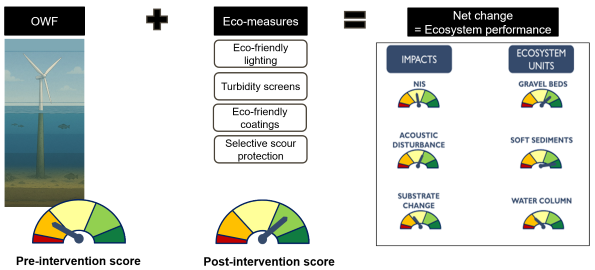
MEsP framework with pre- and post-intervention scoring: baseline impacts of the project (pre-intervention) and effectiveness of eco-measures (post-intervention). Net change is your ecosystem performance. (Photo Credit: MEsP team)
What are the four work packages (WP) of the project?
AB: WP1 focuses on developing the MEsP framework and identifying robust quantification methods for environmental impacts, mitigation measures, and nature-inclusive design solutions. WP1 will use the development from dependencies and impacts to measure change in marine ecosystem condition (including capacity to generate ecosystem services) and progress towards achieving a good marine ecosystem quality (targets).
WP2 looks at how to capture the complex interactions and characteristics of the marine environment.
WP3 concentrates on IT integration, creating a plugin-based architecture to support quantitative modules and user interaction. This package will investigate the best type of structure to achieve the plugin architecture required by the Tier 2 approach, with an easily extendable structure and supportive user interface. This WP will also facilitate the possibility to manually integrate required project-specific user input, use open-data sources and visualise/check calculated outcomes.
WP4 ensures stakeholder engagement and validation through test cases in the offshore renewable energy sector.
Throughout the entire project, the MEsP team strives for an equilibrium between scientifically sound assumptions for the different components in the MEsP framework and realistic expectations and ease of use for offshore companies.
What specific advanced methods for environmental impact assessment are being integrated into MEsP 2.0 to enhance its scientific robustness for the marine environment?
AB: During the project, state-of-the-art quantification methods will be investigated and selected per impact based on their scientific robustness to quantify the environmental impacts of blue economy projects but also on their applicability for blue economy companies. These methods will be integrated into pre- and post-intervention scoring systems, ensuring adaptability and stakeholder validation throughout the process. This will enhance understanding of ecosystem responses, offering a more comprehensive and accurate tool for sustainable decision-making in marine environments.
One example is the impact on climate regulation, with calculations of emission reduction from the renewable energy production from the windfarms, emissions from transport and installation activities, emissions from disturbing the seabed, but also carbon sequestration from the reef effect on the windfarm turbines. Furthermore, eco-measures are investigated to lower emissions and enhance carbon sequestration potential.
How do you use the tool effectively across varied project contexts and data availability levels?
AB: MEsP 2.0 introduces a tiered methodology that combines scientific rigour with practical usability, enabling businesses to select between simplified (Tier 1) or advanced (Tier 2) impact assessments based on project needs and data availability.
To demonstrate feasibility, a proof-of-concept case study was conducted for a hypothetical offshore wind farm (OWF) construction and operation within the Belgian part of the North Sea (BPNS). Activities such as pile driving, scour protection installation, and long-term exploitation were assessed for their ecosystem impacts.
MEsP 2.0 investigates the integration of the quantitative data in the backend framework and the visualisation of results of the assessment in a clear dashboard-like overview. Consideration will be made on how to expand to other sectors and geographical scales, too. The challenges of this work package are to integrate data from different external sources (open data as well as privately owned data) and translate this into a comprehensive framework with useful and understandable output for the end user. The output is a dashboard-vision of the MEsP framework to be seen as proof of concept for further development into a market-ready tool.
The aim is to expand the MEsP framework to other blue economy activities within a wider geographic setting later on.
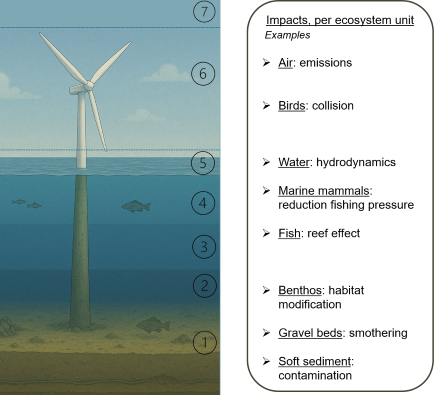
Example of offshore impacts included in the MEsP tool, specified in different ecosystem units of the marine environment such as the seabed, watercolumn, airspace and different biota. (Photo Credit: MEsP team)
What has been the feedback on the tool, and how are its findings being used to mitigate environmental impacts?
AB: The tool is still under development. By involving industry and knowledge institutes in workshops, WP4 guarantees that the MEsP framework meets business needs and supports sustainable decision-making while maintaining scientific robustness and soundness along the way. Topics such as user input, user friendliness, Tier 1 vs. Tier 2 approach and output expectations will be discussed with the companies.
After developing the MEsP 2.0 approaches for a hypothetical test case relevant for the Belgian part of the North Sea, the project team seeks to apply the advanced approach to two real test cases by collaborating with volunteer companies. The MEsP team wishes to announce the possibility of free case study assessments as part of our dedicated validation process in the second year of the project (starting later in 2026).
While the advice given in this editorial content has been developed using the best information available, it is intended purely as guidance to be used at the user’s own risk. No responsibility is accepted by CEDA or by the Intent Communications Ltd or by any person, firm, corporation or organisation who or which has been in any way concerned with the furnishing of information or data, the compilation, publication or any translation, supply or sale of this Guidance for the accuracy of any information or advice given herein or for any omission herefrom or from any consequences whatsoever resulting directly or indirectly from compliance with or adoption of guidance contained therein even if caused by a failure to exercise reasonable care.