Attitude is key
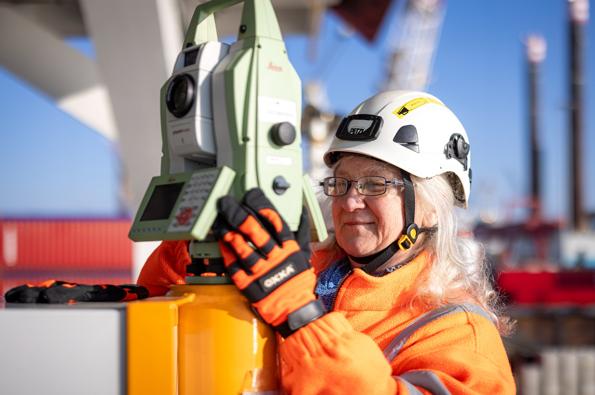
Image 1: Caroline (Rolien) Besancon, Hydrographic Surveyor at Van Oord (photo credit Anne Reitsma)
What was your motivation to enter the dredging industry?
Caroline Besancon (CB): I come from a deeply Dutch maritime family on both sides. My father was in the navy and then later in fishery research. He subsequently moved on to searching for submarine wrecks from the Second World War, as his father died on one, and he found that particular submarine by coincidence. This find led him to search for others. He also found old Dutch Indian vessels with porcelain utensils within. So, from a very young age, the maritime world was always present in my life from my father’s side, with my grandfather, great-grandfather, and great-great-grandfather all involved in sailing or the navy.
My mother also comes from a sailing family. My maternal grandfather was in the Merchant Navy and worked in the Dutch Indies, and his brother was involved in trade in China. So, my whole family history is about working abroad and sailing.
When I was 18, I initially considered the technical school for shipbuilding, but then I discovered a new subject: hydrographic surveying at the Amsterdam University of Applied Sciences. I found it really interesting, partly because of the work that was ongoing to protect Zeeland from high sea levels with the construction of dams, storm surge barriers and dikes. That visual motivation, combined with the fact that my grandfather had also attended the same college, helped me decide to go there, even though no one in my family was from a construction background.
You would have been one of the very few women in the programme when you started your training. What were the challenges, and how did you overcome them?
CB: Yes, that goes back even further. In the Netherlands, there was government propaganda; a campaign called Een slimme meid is op haar toekomst voorbereid (A smart girl is prepared for her future), motivating girls to study math and science and choose those higher-level subjects around age 12 or 13, which are necessary to attend technical university or nautical college. I was one of the few girls who chose to study maths and science at that higher level when I was 14.
At the nautical college, there were about six to eight girls among 300 boys. So, from day one, I was in the boys' class. It was definitely a challenge. The first thing you always hear is that girls are not good with technical subjects. At the nautical college, some teachers wouldn't even say good morning to me because they didn't want girls at the school.
When I started working, I expected the older men to be difficult, but it was the younger men in their 30s who were unpleasant. The older generation was often surprised, saying, "Wow, a girl on board! This is something new."
Your attitude is key. At that time, I felt that I had to blend in with the men and not stick my head above the others, so that I was not seen as a threat.
I was also lucky because some of the major projects I did were in Norway, which was an easier country to work in. If they had sent me to work in dredging projects in places like the UK at that time, it would have been harder. Even later, with ten years of experience, people in some countries would assume I was the secretary. They simply couldn't imagine a female hydrographic surveyor or engineer; some countries were really behind.
How did you transition from your training to the offshore industry?
CB: During my training year, a teacher pushed me towards the navy, but they didn't have female surveyors at that time. I got my main training at ACZ Marine Contractors, which is now part Van Oord; they were building dikes, dams and rock dumping and were involved in the Eastern Scheldt Project, which was a great fit for my motivation.
For some reason, I ended up in the offshore industry when I started working. It was completely different, but I think it was a good move because countries like Norway, where I mostly worked, were much more progressive regarding women in shipping and technical roles. It feels like a coincidence that I landed in the offshore sector. From there, I got into dredging and coastal construction, and then suddenly into offshore wind. Sometimes, you're just lucky to be in the right place at the right time.
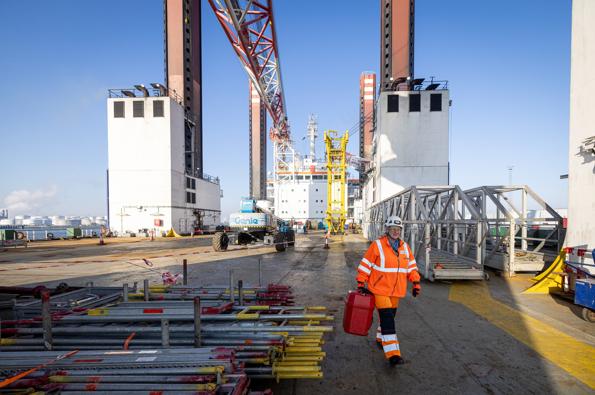
Image 2: Caroline at work: “I’m a land surveyor at sea” (photo credit Anne Reitsma)
What is the role of a Hydrographic Surveyor?
CB: In short, I always tell people I'm a land surveyor, but at sea because most people know who a land surveyor is and not a hydrographer. Of course, the equipment is different. We have to look into the water and measure the seabed, specifically how deep it is. We do this for various projects. For maintenance dredging, you might survey the same area twice a day to guide the hopper dredger. We create maps that show the difference in the seabed after dredging, and also provide the cubic meters dredged, so that clients can pay the companies.
Surveying is really important, especially in precision work. With offshore rock installation, you can only deposit the stones once, because if they land in the wrong spot, you have to retrieve them. Similarly, with offshore wind, you can only place the monopile once in the right location and inclination. It's very specific work. The spectrum of work is wide. A hydrographic surveyor for dredging might be on a small boat doing surveys with a multi-beam, while one on an offshore installation vessel might be using equipment much more akin to land surveying. Projects can involve capital dredging or maintenance dredging.
My work is very flexible, moving from one country to another, or from a small job to a very large one, depending on the project. I enjoy coastal construction. It’s rewarding because you arrive at a location, and there's nothing. But once the work is finished, you will see a dam, a nice beach, or new coastal protection.
What are the highlights of your career?
CB: One of the most interesting dredging projects that I worked on is the Ketelmeer remediation and beach nourishment project in the Netherlands. It was a dredging project that required extremely high accuracy, as we were only allowed to remove a minimum layer of polluted silt. We had 25 surveyors and only three superintendents. It was a state-of-the-art assignment.
I also worked on the maintenance of the Ymuiden and the Ghent-Terneuzen canal in the Netherlands. Away from home, I worked on dredging projects in St Petersburg, Siberia and Sakhalin in Russia, Tunisia, Mexico, and the UK. I have also worked offshore on subsea rock installations, offshore wind monopiles, cable laying, and trenching.
I worked on the Dutch second offshore wind farm, Luchterduinen in the Netherlands, and thereafter five more. I was also involved in the deepest water rock installation at that time. For me, being a part of all these ‘first moments’ is a highlight in my career.
With sectors such as dredging needing to attract new talent, how can we encourage youth to enter this industry?
CB: That is a huge problem. We don't see youth interested in pursuing technical subjects. In the past, travelling was expensive, and working for a company that allowed you to travel around the world was a big incentive. Now, cheap air tickets mean the need to travel through work is less. It is difficult to find people, both men and women, who want this life because it requires being far away from family and friends, and also sacrificing certain special days or events.
On the other hand, it offers a lot of freedom. When I started working, one month on, one month off, in the 90s, my father called it a holiday job. However, many people don't see it like that. We have a big group of surveyors who are adventurous; they like the rotation because the month off allows them to travel, windsurf, or sail. They are people who don't want a 9-to-5 office job; they want to change things up.
Open days at schools, and also programmes where students can spend a few days observing a job, are helpful. I know in the Netherlands there is a special "girls' day" in April where young girls can visit technical companies to see what the job entails. This is how we have to encourage younger people into technical education.
For recruitment, the traditional ways aren't working anymore. Since young people are more digital and constantly on platforms like TikTok and other media, that is where we need to find them and incite their interest.
If you have an idea or a dream to do something, you should try it and not give up.
Rolien is also featured in the Maritime Women exposition at the Rotterdam Maritime Museum and online. For more information visit: https://maritiemmuseum.nl/en/exhibitions/maritime-women
While the advice given in this editorial content has been developed using the best information available, it is intended purely as guidance to be used at the user’s own risk. No responsibility is accepted by CEDA or by the Intent Communications Ltd or by any person, firm, corporation or organisation who or which has been in any way concerned with the furnishing of information or data, the compilation, publication or any translation, supply or sale of this Guidance for the accuracy of any information or advice given herein or for any omission herefrom or from any consequences whatsoever resulting directly or indirectly from compliance with or adoption of guidance contained therein even if caused by a failure to exercise reasonable care.