Building a blueprint through collaboration
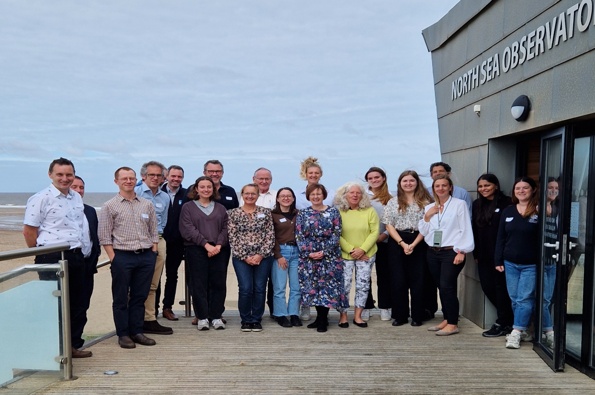
Task and Finish Group (Image credit: Haskoning)
MNG is the idea that marine development should leave the marine environment in a better overall condition than before, by supporting environmental improvement beyond existing mitigation and compensation requirements. Its impact, however, will depend on how it is designed and delivered. For the marine sector, the challenge is to ensure that any future approach is practical for developers, credible for regulators and capable of delivering environmental improvements beyond existing mitigation and compensation requirements. The issue comes against a wider biodiversity challenge in UK waters, where environmental recovery and marine development increasingly need to be considered together.
In 2021, a cross-sector Task and Finish Group (T&F Group) was established to explore how Marine Net Gain could be delivered more effectively. It brought together ports, offshore wind, environmental organisations, regulators, consultants and industry bodies, alongside participation from Defra, Natural England and The Crown Estate.
The project forms part of the Offshore Wind Evidence and Change programme, led by The Crown Estate in partnership with the Department for Energy Security and Net Zero and the Department for Environment, Food & Rural Affairs. The programme is a strategic, research and data-led initiative designed to support the sustainable and coordinated expansion of offshore wind, helping to meet the UK’s low-carbon energy transition commitments while supporting clean, healthy, productive and biologically diverse seas.
Speaking to CEDA Industry News, Peter Barham, Chair of the Task and Finish Group, said the process helped establish agreement across stakeholders. “It meant we were working from a common baseline,” he said.
The process has since evolved into a blueprint for how Strategic Marine Net Gain (SMNG) could be structured, funded and applied across different marine contexts.
Why a strategic approach was needed
The work of the T&F Group forms part of the Offshore Wind Evidence and Change programme, led by The Crown Estate in partnership with the Department for Energy Security and Net Zero, and the Department for Environment, Food & Rural Affairs. The Offshore Wind Evidence and Change programme is an ambitious strategic research and data-led programme. Its aim is to facilitate the sustainable and coordinated expansion of offshore wind to help meet the UK’s commitments to low carbon energy transition whilst supporting clean, healthy, productive and biologically diverse seas. The T&F Group was created to explore how MNG could be delivered more effectively within the realities of marine planning, licensing and development. Barham explained that one of the group’s early priorities was ensuring that industry and environmental stakeholders had an opportunity to help shape the conversation before any formal framework was introduced. “The group recognised the importance of contributing to the discussion early and helping shape a framework that could work effectively within the marine environment,” he said.
A key focus quickly became the risk that MNG could be applied too narrowly, with environmental contributions tied to individual project footprints rather than wider ecological priorities. Instead, the group explored whether strategic targets could direct restoration efforts towards areas where intervention would provide greater ecological value. “The aim was to avoid fragmented delivery and instead focus on measures that could contribute to more meaningful environmental outcomes at a larger scale,” Barham said.
He also outlined that SMNG should remain distinct from existing mitigation and compensation requirements already embedded within marine licensing and environmental legislation. Rather than replacing those obligations, the concept is intended to sit alongside them by supporting additional environmental enhancement and recovery opportunities beyond the direct impacts of individual developments.
Building the evidence base
The T&F Group moved beyond high-level discussions around MNG and began examining how a strategic framework could operate in practice. Phase One focused on identifying environmental priorities and developing strategic targets to support long-term marine recovery, while Phase Two explored how those targets could be realistically delivered.
A major part of the effort involved reviewing existing restoration initiatives and gathering evidence from across the marine sector. According to the group’s final report, the first call for evidence identified more than 700 restoration projects and proposals linked to marine and coastal recovery. The findings gave a clearer evidence base for assessing which types of restoration activity were already being attempted, where delivery barriers existed and how future MNG contributions might be directed.
The study examined restoration opportunities across a range of habitats and species, including salt marsh creation, seagrass restoration, native oyster reef recovery, mudflat enhancement and subtidal habitat improvement. It also considered wider pressure reduction measures, such as actions linked to improving water quality and supporting habitat recovery. “The focus was on identifying where strategic delivery could achieve the greatest long-term environmental value,” Barham said.
The group also examined the practical barriers that can affect marine restoration, including monitoring requirements, uncertain ecological outcomes and the need to align activity across multiple organisations. According to the report, this type of strategic approach was considered particularly important within the marine environment, where restoration techniques are often complex, evolving, and dependent on long-term coordination among multiple stakeholders.
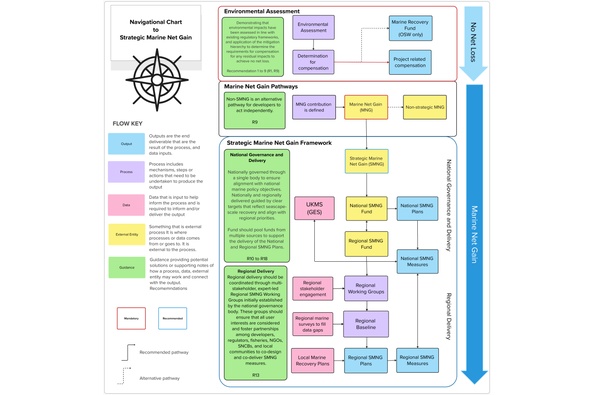
Navigational Chart to SMNG - A high‑level overview of the SMNG framework and how MNG and SMNG connect with existing regulatory obligations. (Image credit: Task and Finish Group, Marine Net Gain Report)
Testing the framework in practice
Following the first two phases of work, the T&F Group moved towards examining how SMNG could operate at a regional level. Phase Three focused on the East Marine Plan area as a case study, testing how strategic targets could be translated into regional priorities within an active marine planning environment. The case study also considered local ecological needs, existing marine activities, licensing, consenting and the long-term requirements of project delivery.
Governance was another central focus. The report highlights the need for transparent decision-making, clear roles and evidence-led review so that any future framework can adapt as ecological conditions, restoration evidence and delivery experience evolve.
Barham said one of the key objectives was ensuring that any future framework remained practical for developers while still delivering measurable environmental benefit. “There was a strong focus throughout the work on developing something that could be applied realistically within the marine environment,” he said.
The aim was not to create a rigid model, but to show how strategic principles could be applied in real marine planning contexts.
From principle to practice
The marine sector is now left with a clear question: how can SMNG be translated from a collaborative proposal into a workable policy approach?
For the T&F Group, the blueprint is already there. The challenge is to ensure that any future framework remains simple enough for developers to use, robust enough to satisfy regulators, and ambitious enough to support genuine, large scale marine recovery.
The T&F Group plan to meet on a frequent basis to discuss actions and promote the importance of marine restoration to Government and relevant stakeholders. The Group will continue to develop the concept of marine industries contributing to strategic marine restoration through the recommendations they have developed and actively encourage Government to implement these to ensure that industry plays a meaningful role in the restoration our seas deserve.
If taken forward, the recommendations could help move MNG from principle to practice, giving the industry a clearer route to support marine recovery in a way that is structured, credible and achievable.
While the advice given in this editorial content has been developed using the best information available, it is intended purely as guidance to be used at the user’s own risk. No responsibility is accepted by CEDA or by the Intent Communications Ltd or by any person, firm, corporation or organisation who or which has been in any way concerned with the furnishing of information or data, the compilation, publication or any translation, supply or sale of this Guidance for the accuracy of any information or advice given herein or for any omission herefrom or from any consequences whatsoever resulting directly or indirectly from compliance with or adoption of guidance contained therein even if caused by a failure to exercise reasonable care.