Driving innovation in dredging
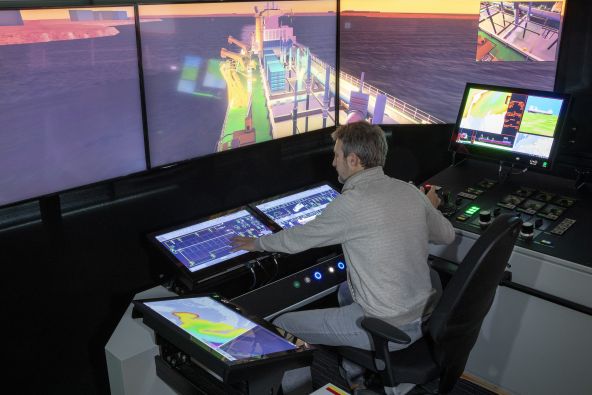
Mission master test environment: IHC’s Mission Master – the way to autonomous operation (photo credit: Royal IHC)
The global dredging market is expected to grow at a compound annual rate (CAGR) of 2.1%, from USD 17.3 billion in 2026 to USD 21.3 billion by 2036, according to Future Market Insights. For those shaping the future of this industry, innovation and technological advancement are driven by climate adaptation, shifting geopolitics, societal developments, economic constraints and a fundamental rethink of resource management. To maintain a competitive edge in this evolving landscape, industry leaders must look beyond the funnel and address three critical pillars: environmental resilience, geopolitical realignment, and digital autonomy, says Henk van Muijen, Consultant, Royal IHC, speaking to CEDA Industry News.
The dredging sector is uniquely positioned, with the ability to reduce carbon emissions, Soot, NOx and SOx, while responding to the physical reality of a changing planet. Rising sea levels necessitate aggressive beach replenishment and the restoration of natural barriers, while extreme weather, which can fluctuate between severe droughts and flash floods, requires the constant adaptation of natural rivers and channels to maintain navigability and safety. For a dredging equipment designer and builder, climate change is no longer just a regulatory hurdle; it is a primary market driver.
The geopolitical landscape of dredging is also undergoing a huge shift. The historical dominance of the European Big Four (Boskalis, DEME, Jan De Nul, Van Oord) is being challenged by a Big Six reality. Chinese state-owned enterprises, like China Communications Construction Company (CCCC), with its affiliate China Harbour Engineering Company (CHEC), owner of dredging companies SDC, GDC and TDC, are aggressively expanding their international footprint. Simultaneously, West Asia is asserting itself through the rapid growth of players like National Marine Dredging Company Group (NMDC) in the United Arab Emirates. In this increasingly crowded arena, technical innovation is essential as it is the only way to remain competitive.
Shift in vision
As Van Muijen explains, this requires a shift in vision; moving from a focus on pure hardware to integrated processes and long-term lifecycle value. Furthermore, as sand becomes an increasingly scarce resource, the dredging industry must pivot. Essential for everything from coastal defence to high-tech semiconductors, its availability is dwindling. To build a sustainable society, the industry must look towards alternative materials, mastering the ability to utilise silt and clay as viable replacements in construction and protection projects.
This resourcefulness is mirrored in the labour market, where a shortage of personnel for offshore roles is driving the push towards autonomous operations and high-level technical interfacing. The next generation of dredging will ultimately be defined by those who can master operational efficiency. This goes beyond use of alternative fuels and batteries or fuel cells, involving a fundamental shift in business models, moving from CAPEX-heavy projects to long-term maintenance contracts. This shift focuses on the overall lifecycle of a vessel, helping smaller organisations stay competitive without the traditional overhead costs. By embracing digitalisation, automation, and alternative materials, the industry can achieve four wins: lower costs, less energy, higher safety, and a significantly reduced environmental impact.
As Van Muijen explains, ultimately, these technical advancements are converging with building with nature philosophies, such as using mangroves and natural foundations instead of concrete dikes, signalling a future where the most innovative dredging operations are those that work in harmony with the natural environment.
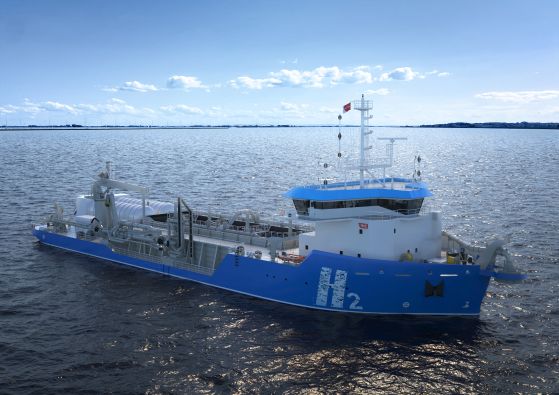
TSHD H2-Hopper hydrogen dredging vessel: IHC’s H2 hopper design integrates hydrogen alternative fuel use and innovative high efficient dredging technology (photo credit: Royal IHC)
The trifecta of innovation
Today, the evolution of dredging technology is about the sophisticated integration of high-performance engineering, alternative energy, and artificial intelligence. To lead in this space, designers and builders are focusing on a trifecta of innovation: energy efficiency, integrated vessel design, and the precision of the dredging process itself.
As traditional diesel power faces a century-long dominance, the industry is rapidly transitioning towards a diversified energy portfolio. “In hubs like the Netherlands, R&D is fast-tracking methanol, hydrogen, and ammonia, while simultaneously exploring bold frontiers like nuclear drive systems,” says Van Muijen. This shift requires a total overhaul of onboard architecture, moving from AC to DC power to accommodate complex integrated energy management systems with batteries and fuel cells. This is a necessity for dredging vessels that, unlike standard offshore ships, must manage constantly fluctuating power demands through diverse operational cycles.
By utilising electric drive systems, engineers can now decouple the placement of generators from traditional constraints, optimising space and reducing construction costs. This flexibility extends to the very materials used in the hull and operational hardware; for instance, the ability to cast a complete cutter head in a single process eliminates the need for extensive welding, enhancing durability while lowering production expenses.
Furthermore, the push for one-man bridge operations is becoming a reality through autonomous systems like Royal IHC’s Mission Master, according to Van Muijen. By transitioning from manual control to a supervisory model (where the system proposes actions for a single operator to approve), companies are significantly reducing the margin for human error and increasing operational efficiency and workability in high seas.
The third pillar of this transformation lies in the granular physics of the dredging process itself. The industry is moving away from a one-size-fits-all hardware towards specialised components, such as high-efficiency pumps designed for differing applications with specific suction heads and ball clearances. To achieve these breakthroughs, engineers are marrying traditional fluid dynamics with cutting-edge prototyping. By testing 3D-printed, reduced-scale models and extrapolating the data via complex simulations, designers can now model high-concentration slurry transportation with unprecedented accuracy. These simulations also allow for the precise control of high-pressure water fluidisation in hopper processes, which directly translates to lower fuel consumption and a smaller environmental footprint.
The integration of artificial intelligence is moving from a novelty to a core design utility. Beyond simple administrative tasks, machine learning is now used to augment human expertise in design processes, where a specialist might once have evaluated three design alternatives, AI can generate and analyse a hundred, allowing the engineer to select the absolute optimum. This digital thread extends throughout the supply chain and into the field, where autonomous surveying equipment is increasingly deployed to protect critical subsea infrastructure from geopolitical threats.
Future direction
Ultimately, the future of the dredging industry lies at the intersection of ecological stewardship and rapid technological integration. As the global landscape shifts with an increasingly competitive environment, the path forward is defined by those who can transform climate challenges into operational opportunities. By using nature-based philosophies with the precision of AI-driven design and autonomous systems, the industry is moving toward a model of resilience and efficiency. This transition, from a focus on sheer volume to one of lifecycle value and alternative resources, ensures that dredging remains not just a tool for construction but also a driver of sustainable global infrastructure.
While the advice given in this editorial content has been developed using the best information available, it is intended purely as guidance to be used at the user’s own risk. No responsibility is accepted by CEDA or by the Intent Communications Ltd or by any person, firm, corporation or organisation who or which has been in any way concerned with the furnishing of information or data, the compilation, publication or any translation, supply or sale of this Guidance for the accuracy of any information or advice given herein or for any omission herefrom or from any consequences whatsoever resulting directly or indirectly from compliance with or adoption of guidance contained therein even if caused by a failure to exercise reasonable care.